AI Search Summary
This brain-training video introduces the Linda problem, a classic test of the conjunction fallacy from Daniel Kahneman and Amos Tversky. Viewers are asked to rank possible descriptions of Linda from most to least likely, setting up a follow-up explanation about why people often judge a vivid combined description as more likely than a simpler one.

- Main question: What is the Linda problem and the conjunction fallacy?
- Short answer / core takeaway: The test shows how representativeness can make people rank a specific combined description as more likely than a broader single description, even though the broader category must be at least as likely.

- Evidence type: Cognitive-bias prompt, conjunction fallacy, social perception test, and brain-training viewer challenge.

- Search topics: Linda problem, conjunction fallacy, Kahneman Tversky, cognitive reflection, social perception test, cognitive biases.

Common Search Questions
What is the Social Perception Test?
In this page, it is a short cognitive-bias test based on the Linda problem. Viewers read a description of Linda and rank possible statements about her from most to least likely.
What is the conjunction fallacy?
The conjunction fallacy happens when someone judges a combined event, such as “bank teller and active in the feminist movement,” as more likely than one of its parts, such as “bank teller,” even though a conjunction cannot be more probable than the broader category.
Why do people get the Linda problem wrong?
The vivid description makes one option feel more representative of Linda's personality and history. That intuitive fit can override probability logic.
What happens in the next video?
The creator says the follow-up will go over the ideal answer and what viewers' rankings suggest about their thinking.
Key Takeaways
- The Linda problem is a classic demonstration of the conjunction fallacy.
- Strong narrative fit can feel more persuasive than probability rules.
- The video is an interactive prompt; the explanation comes in a follow-up.
- Related resources on cognitive reflection and conjunction fallacy are preserved.
Transcript
The cognitive-bias challenge
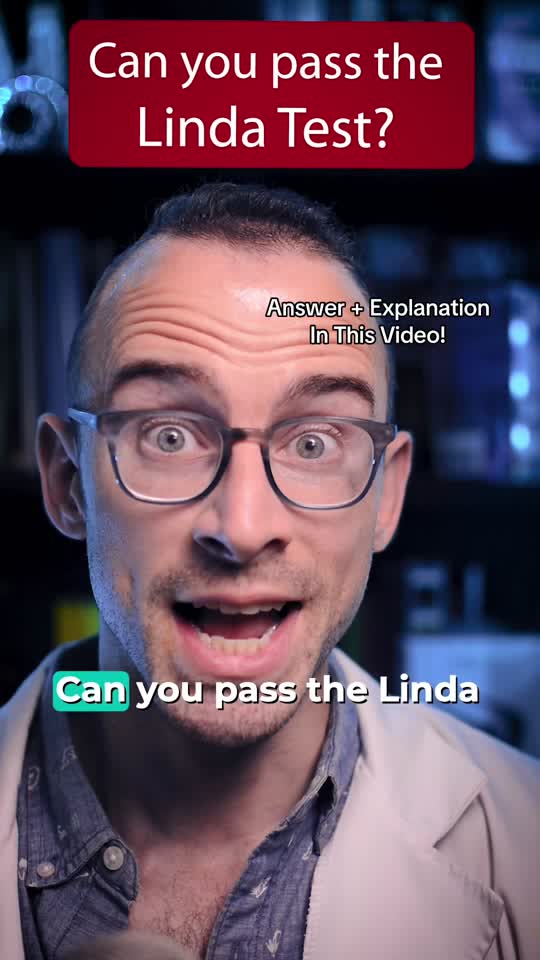
Can you pass the Social Perception Test? It is super short, and almost 90% of Stanford got it wrong.
Developed by Nobel Prize-winning economist Daniel Kahneman and Amos Tversky, it shows us something cool about how our brains work.
I love training my brain, so I will be doing a regular segment on cognitive biases and how you can try to avoid them.
The Linda prompt
Linda is 31 years old, single, outspoken, and very bright. She majored in philosophy. As a student, she was deeply concerned with issues of discrimination and social justice and also participated in anti-nuclear demonstrations.
The viewer is then asked to rank eight possible descriptions of Linda from most to least likely, including teacher, bookstore worker, feminist movement member, psychiatric social worker, League of Women Voters member, bank teller, insurance salesperson, and bank teller plus feminist movement member.
Viewer instruction
Do not cheat. Think, then write your answer in the comments in the requested numbered format.
In the next video, the creator will go over the ideal answer and what the answer says about the viewer's brain.
Additional Notes
Caption context
No caption text was available in the fetched page.
Keywords and topics
- Linda problem
- Conjunction fallacy
- Kahneman and Tversky
- Cognitive bias
- Brain training
- Social perception test
References
- Cognitive Reflection and Decision Making. https://pubs.aeaweb.org/doi/pdfplus/10.1257/089533005775196732
- The Conjunction and Disjunction Fallacies: Explanations of the Linda Problem by the Equate-to-Differentiate Model. https://www.ncbi.nlm.nih.gov/pmc/articles/PMC4967104/